
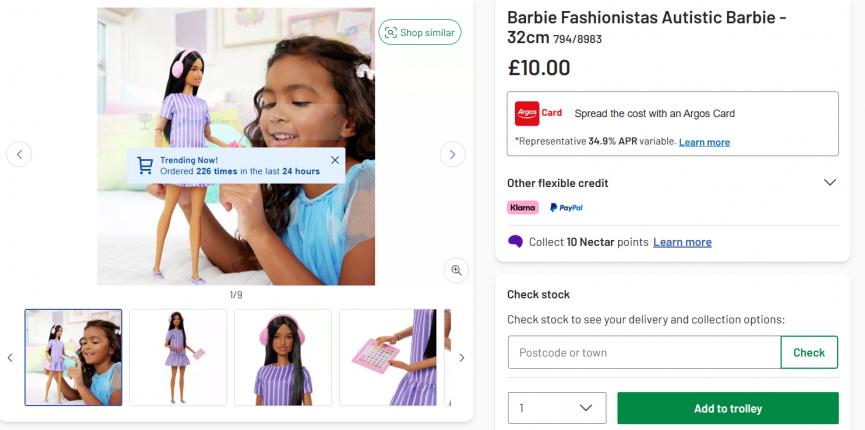
Barbie has just launched their first autistic doll, a move which has been welcomed by campaigners and charities as a step towards more representation for neurodivergent children. The doll features specific design choices intended to reflect some experiences to which autistic people might relate. We have found stock of this doll in the UK already, move fast though as we have a feeling it will be popular!
Every design choice reflects something real for many autistic children, claims Mattel. The doll has the following:
- Side-gaze eyes to mirror how some autistic people avoid direct eye contact
- Noise-cancelling headphones to support kids who find loud spaces overwhelming
- A fidget spinner that actually spins
- A communication tablet showing AAC symbols for non-verbal or low-verbal communication
- Fully bendable arms and wrists, so kids can copy hand movements like flapping or stimming
- Loose, soft clothing and flat shoes to reduce rubbing and sensory overload
Mattel says this kind of inclusive play 'can help children better understand the world around them by encouraging doll play outside of their own lived experience'.
The Autistic Self Advocacy Network helped shape the doll and said: ‘It is so important for young autistic people to see authentic, joyful representations of themselves.’
Peter Watt, Managing Director of National Programmes at the National Autistic Society, said: 'Seeing more depictions of autism is key to understanding and autism acceptance.
'It's really important that these representations are authentic and based on extensive consultation with autistic people, and we're pleased Mattel involved the autistic community in the development of this doll.
'Autism is a spectrum condition, and each autistic person has a unique combination of characteristics.
'It's important to remember autistic people can be very different to each other, with different sets of strengths and challenges.
'It is positive to see authentic autistic representation on TV and films, the arts and in play, as better public understanding of autism across society could transform hundreds of thousands of autistic people's lives.'
As a Mum to an autistic daughter, it makes me emotional to see this doll, I want her to feel seen and recognised and to have representation amongst a very neurotypical world. This Barbie has been designed alongside autistic people, not just for them, as part of a plan to show how different children experience the world. And although there are going to be people who say that this doll reinforces stereotypes of autism, I personally feel that a doll cannot possibly represent the whole autistic spectrum so Barbie was never going to win over everyone. But I am overjoyed that finally this feels like a step in the right direction for representation.
I will say though that my teenage daughter was the first to tell me about this doll, with a huge smile on her face, despite knowing that some of the traits shown are stereotypical and not relevant to her. She still felt seen, acknowledged and excited, that this may help so many children like her throughout the world. And at the end of the day that made me smile too.



Comments